
On this page
A scratching post needs to fit the cat, withstand being pulled at and stand somewhere the cat actually goes. The colour can have a vote once those jobs are covered.
Start with how your cat scratches
Watch the position: upright against furniture, stretched out over a flat surface, or on an angle. That observation is more useful than a listing saying “for all cats”. If you are preparing for a new arrival, ask the rescue or previous owner which scratching surfaces the cat uses.
Cats Protection explains that scratching is normal behaviour, including claw maintenance and marking territory. It recommends a sturdy post that allows a full stretch, and notes that some cats prefer horizontal surfaces. A cat scratching the carpet has supplied some product research, albeit on the carpet.
Scroll across to see the full table.
| Observed preference | Layout to consider | Check |
|---|---|---|
| Reaching up a vertical surface | Upright post or securely fitted panel | Uninterrupted scratching height and resistance to movement |
| Scratching along the floor | Flat board or pad | Room to stretch and whether it slides on your flooring |
| Scratching on a slope | Angled board | The usable slope, support underneath and full footprint |
How tall should a scratching post be?
Look for room for your cat to stretch fully, rather than treating one advertised height as right for every adult cat. Cats Protection gives around 60cm as a starting point for an average adult moggy; the full-stretch requirement matters more than the number. A longer cat may need substantially more room.
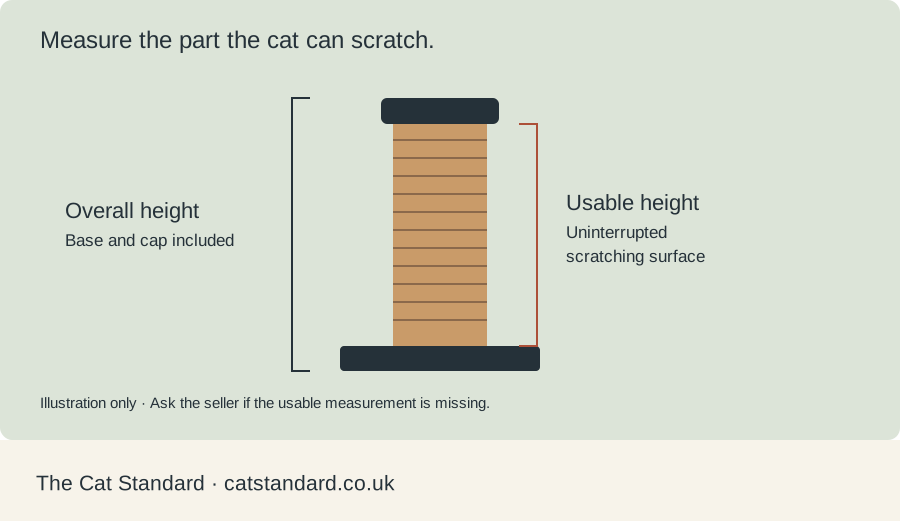
Overall height and usable scratching height are different measurements. A base, cap, platform or section covered in a different fabric can count towards the first without adding to the surface you want. Ask for the uninterrupted scratching length if the listing gives only the assembled dimensions.
Measure the space at home too. Record the base width and depth, leave access around the post, and check that a door will still open. A corner can look generously sized until you introduce a square base.
Check stability and assembly before calling it finished
A large-looking base in a photograph is not a stability test. Compare its actual footprint, the post connection and the assembly instructions. Once assembled, check for rocking, loose fittings and sliding on the floor where it will be used. If it feels insecure, resolve that before introducing the cat.
Follow the supplied assembly method. Wall-mounted and tension-mounted designs need their own fixing and surface requirements; a freestanding post is not automatically suitable for conversion. Keep the instructions and check fixings again as part of routine inspection.
Choose a surface, not just a material label
Compare woven fabric, wound rope and corrugated cardboard as different constructions. Look at the area available to scratch, how the surface is attached and what can be replaced when it wears. “Natural” on a listing does not tell you any of those things.
A cardboard board can be a straightforward way to offer a horizontal surface. A rope-wrapped or woven post offers an upright option, but the cat still needs enough stretch and a stable base. Start with an observed preference where you have one; there is no need to furnish an entire scratching department on day one.
For the differences between rope, woven fabric and replaceable boards, read cardboard vs sisal cat scratchers.
Three UK buying options to compare
These are researched examples of different layouts and sizes. Specifications below come from the linked manufacturer information and UK listings, checked on 13 September 2026. Availability, sellers and selected variants can change.
Scroll across to see the full table.
| Product | Why consider it? | What to check |
|---|---|---|
| SmartCat Ultimate Scratching Post in grey | Taller woven-sisal design: advertised height 32in (about 81cm), base 16 × 16in (about 41 × 41cm). | These are overall dimensions, not a verified uninterrupted scratching length. The manufacturer does not sell replacement sisal covering. |
| Trixie Parla in beige | Simple upright design: advertised height 62cm and base 40 × 40cm. | Check your cat’s stretch. Amazon describes sisal; the manufacturer’s page describes jute. Confirm the supplied covering if that determines your choice. |
| Catit Senses Oval Scratcher | A standalone corrugated-cardboard option for floor-level scratching. | It is not an upright-post substitute for a cat that wants to reach up. Manufacturer and Amazon dimensions differ, so confirm fit if space is tight. |
SmartCat Ultimate Scratching Post in grey
Consider for: a taller upright surface.
Factor in: the base footprint and replacing the post when the covering is finished. The manufacturer’s specification and assembly guidance identify woven sisal and explain that replacement covering is not supplied. Its stability claims are manufacturer claims, not our test results.
Trixie Parla in beige
Consider for: a straightforward shorter post, if it allows your cat a full stretch.
Factor in: the unresolved covering description. The manufacturer lists the beige variant as 43331, with a 9cm-diameter column. We would not buy this specifically for sisal without checking that discrepancy with the seller.
Catit Senses Oval Scratcher
Consider for: adding a simple horizontal scratching surface.
Factor in: floor grip and eventual board replacement. The manufacturer’s UK page lists 24.4 × 48.8 × 3.5cm, while Amazon shows 45.7 × 27.9 × 7.6cm. We have not treated those as interchangeable. It can be used on its own; buying a separate play circuit is optional.
Price the replacement, too
Before buying, find out whether wear means replacing a pad, a column or the whole item. For modular designs, match the exact replacement part rather than assuming that a similar-looking refill fits. Keep the model number with the receipt.
Inspect the surface and structure regularly. Loose components, exposed fixings or a failing base are reasons to take it out of use and follow the maker’s repair or replacement advice. There is no useful universal promise that a post will last a particular number of months.
For a fair budget comparison, write down the purchase cost, the confirmed replacement part and its current price. Leave lifespan blank unless you have evidence for it. Our UK cat costs guide helps separate setup spending from recurring costs.
If you also want raised resting places or climbing levels, use our cat-tree buying guide to check the full footprint, usable platforms and upkeep.
Give it a useful place in the room
Cats Protection recommends offering a post near an area the cat already scratches and advises against taking their paws and forcing the action. Make the alternative available and let the cat investigate.
Try a practical position before deciding the product has failed. A beautifully coordinated post behind a closed door has mostly become an interior-design decision.
Use our scratching-post placement guide for room layouts and access checks.
Preparing the whole home? Use our first-cat essentials checklist. For the growing collection, browse Scratchers & play.
If the post is already in place and still being ignored, work through why your cat is not using the scratching post before replacing it. Location, movement or scratching direction may be the issue.
Sources and selection
We compared manufacturer specifications, UK product listings and Cats Protection’s scratching guidance, checked 13 September 2026. The examples cover a taller upright post, a shorter upright post and a flat board; source disagreements are identified beside the relevant product. Read our editorial standards.